

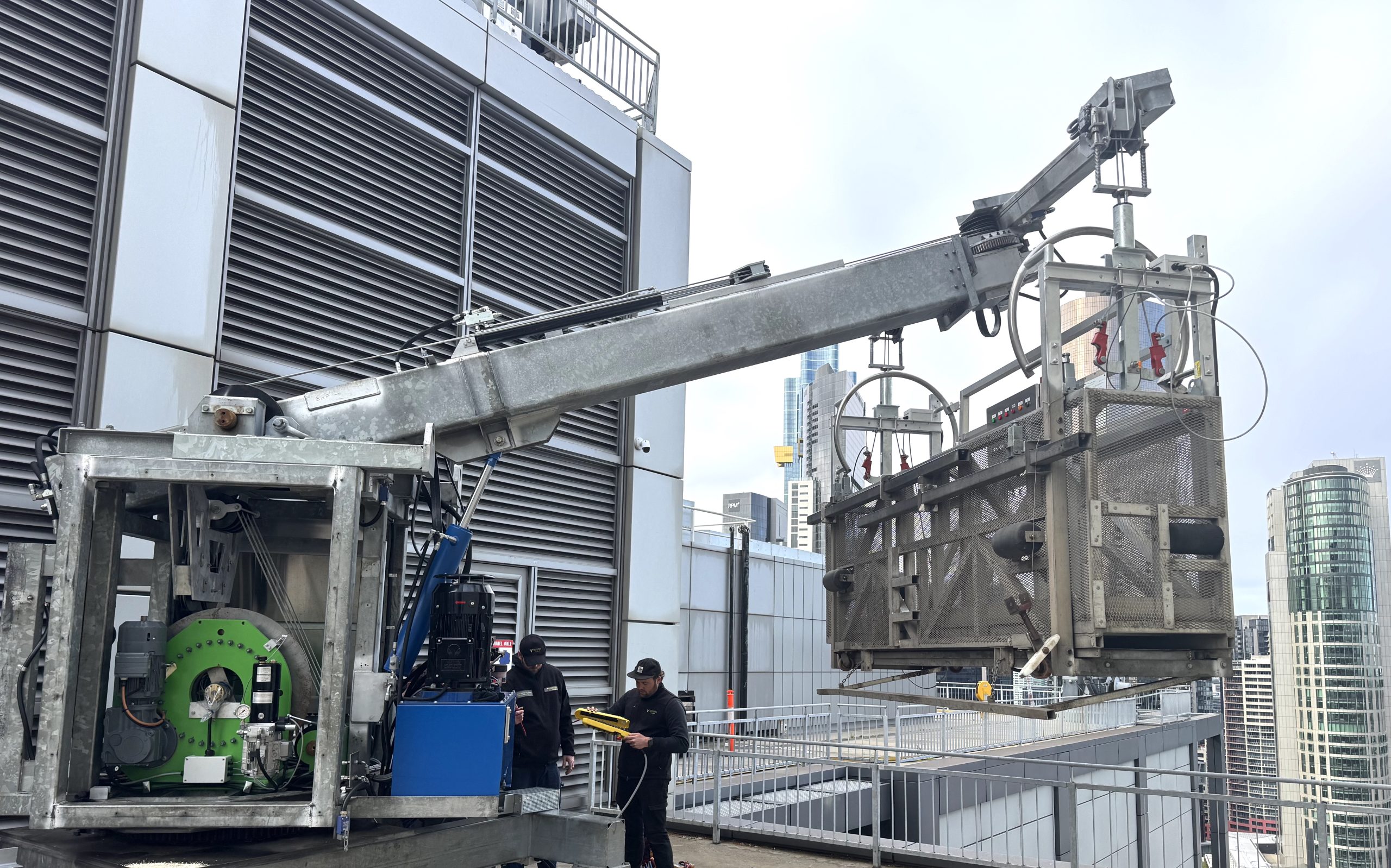
For building owners and facility managers responsible for an ageing Building Maintenance Unit, the decision between upgrading what you have and replacing the entire system is rarely straightforward. Both paths have a cost, a timeline and a set of trade-offs, and the right answer depends on the condition of the specific facade access system.
This article sets out the key factors that determine which approach makes the most sense for your building.
Understanding the Difference
A BMU replacement removes the existing unit entirely and installs a new system, including new tracks, structural supports, winches, controls, cradle and cabling. It is a capital project with a longer lead time and higher upfront cost, but it delivers a modern, warranted system with a new service life.
A BMU upgrade keeps the existing structural frame, tracks and core mechanical components, and upgrades the systems that have deteriorated or become obsolete. This typically includes the winches, electrical controls, cabling and cradle modifications. The result is a machine that operates to current standards at a lower cost and shorter timeline than a full replacement.
When an Upgrade Makes Sense
An upgrade is generally the right path when the structural frame and track system are sound, and the problems are concentrated in the electrical and mechanical systems that have aged or become obsolete.
Common retrofit scopes include:
- Replacing obsolete Tirak winches with modern multi-layering winch systems
- Upgrading relay-based controls to PLC-driven systems with real-time diagnostics
- Rewiring the cage with internal copper conductors, which eliminates the need for Magtron systems and allows the cradle to be hardwired
- Replacing ageing electrical cabinets and control panels
- Engineering solutions for mechanical issues that have been present since the original installation, such as cradle levelling problems
At 141 St Georges Terrace in Perth, Vertimax completed a major inspection followed by a full Tirak winch replacement and electrical upgrade. The project delivered a compliant, reliable system without the cost and disruption of removing and replacing the entire BMU.
At 452 Flinders Street in Melbourne, the scope went further. In addition to replacing the winches and rewiring the entire system, our team engineered a bespoke hydraulic levelling cylinder to solve a cage levelling issue that had been present since the unit was first installed in the mid-1990s. That is the kind of rectification that only makes sense when you have the full history of a building’s access system and the engineering capability to design a solution from scratch.
When Replacement Is the Better Option
There are situations where upgrading an existing Building Maintenance Unit is not the most practical or economical path. These include:
Structural fatigue in the frame or boom. If the primary structural components are showing signs of fatigue or cracking, no amount of electrical or mechanical upgrade changes the underlying risk.
Non-compliant track systems. Where the roof track layout no longer meets current Australian standards (AS/NZS 2550.13), replacement of the full system, tracks included, may be the only compliant path.
Escalating parts costs on a legacy platform. Some older BMU models have reached a point where sourcing replacement components costs more per repair than the equivalent proportion of a new system. When the cost curve tips that way, replacement has a shorter payback period.
Building use or facade changes. If the building has been re-clad, extended or repurposed since the original BMU was installed, the existing system may no longer provide full facade coverage. A new system designed around the current building geometry is the only way to close that gap.
How to Decide
The starting point is always a formal condition assessment of the existing equipment. This should cover the structural frame, boom, tracks, winches, electrical systems, safety devices, wire ropes and cradle condition. It should also include an assessment of parts availability and a clear view of what the system needs over the next five to ten years.
From there, the decision sits on three factors:
- Safety and compliance. Can the existing system be brought to current standards through an upgrade, or does compliance require a full replacement?
- Total cost of ownership. What will it cost to keep the current system running reliably over the next decade, compared to the cost of a new installation with a fresh warranty and service life?
- Operational continuity. How long will each option take the BMU offline, and what is the impact on facade maintenance, cleaning schedules and tenant obligations during that period?
Vertimax Can Help
Vertimax has completed BMU retrofits and full replacements across commercial towers and infrastructure projects throughout Australia. As the exclusive Australian distributor for GIND, a leading European BMU manufacturer, we can supply new facade access systems engineered for your building’s specific requirements. With the bulk of our work completed in-house including mechanical, electrical and structural trades, we can deliver upgrade projects without relying on multiple subcontractors.
If your BMU is approaching 20 years of age, or you are seeing increased callouts and rising repair costs, a condition assessment is a sensible first step. It gives you the information you need to make a decision based on evidence rather than assumption.
Sorry, the comment form is closed at this time.